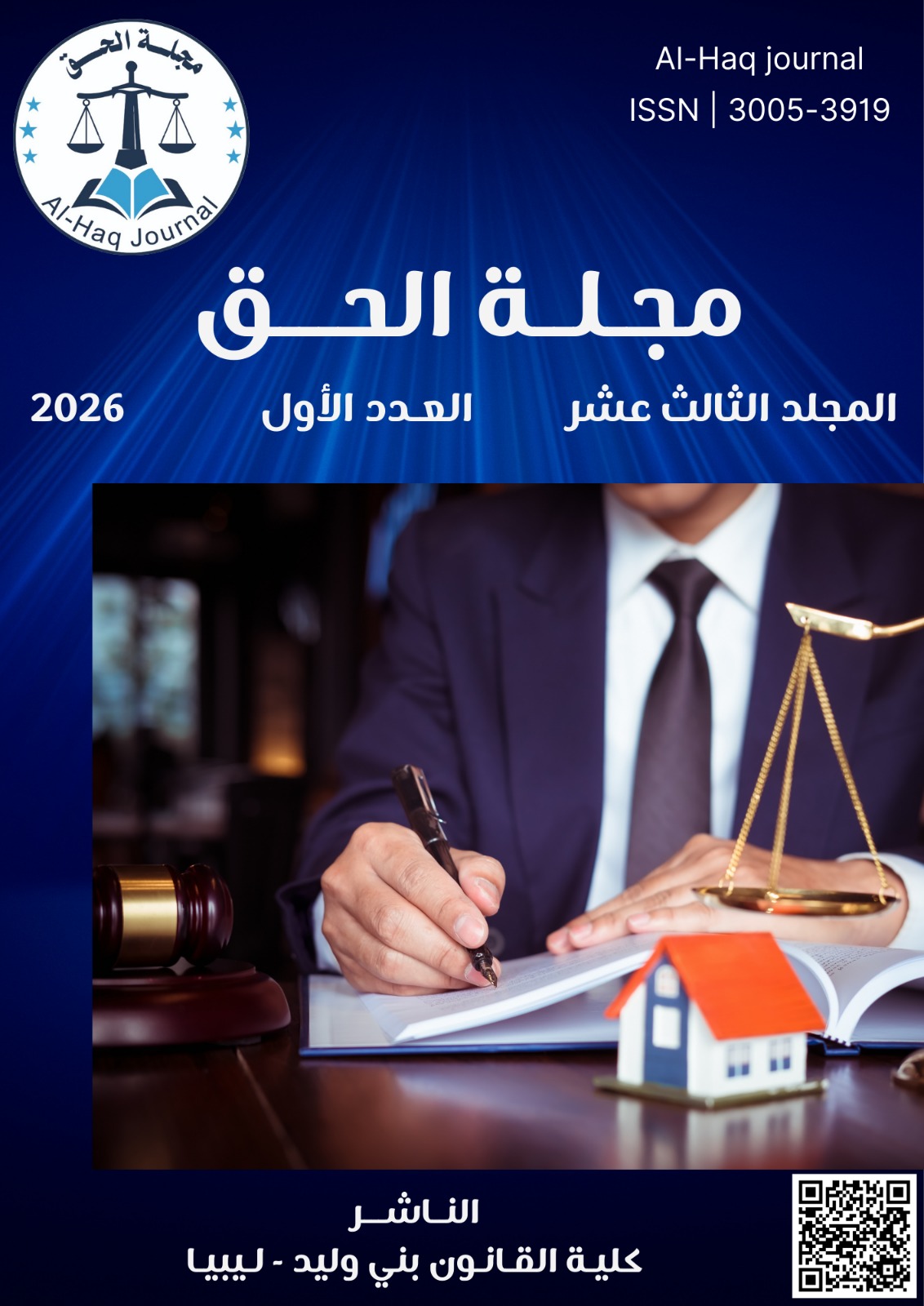
The lack of credibility of the justification leading to the arbitrary termination
DOI:
https://doi.org/10.58916/alhaq.v13i1.453Keywords:
Employment contract, arbitrary termination, serious reason, abuse of right, burden of proofAbstract
This research presents an analytical study of the issue of arbitrary termination of employment contracts within the framework of Libyan labor law, in light of the theory of abuse of rights, considered one of the most important legal mechanisms for protecting the weaker party in the employment relationship, namely the worker. The importance of this topic stems from the increasing number of cases of termination of employment contracts without a serious and legitimate justification, and the resulting impact on job security and social stability.
The research aims to clarify the concept of arbitrary termination, define its legal criteria, and distinguish it from legitimate termination. It also analyzes instances of the absence of a serious justification, whether due to the illegitimacy or triviality of the interest, or the lack of proportionality between the employer's interest and the harm inflicted on the worker. Furthermore, the research addresses the issue of the burden of proof in arbitrary dismissal cases, clarifying the roles of both the employer and the worker, as well as the pivotal role of the judge in assessing the seriousness of the justification based on their discretionary authority and the standard of legality.
The research adopted a comparative analytical approach, examining Libyan legal texts, supported by Libyan and Arab jurisprudence, and national and comparative judicial precedents, particularly those of Egypt, France, and Jordan. The research concluded that arbitrary termination occurs when the dismissal decision lacks a serious and genuine reason, and that the judiciary plays a fundamental role in ensuring legal protection for workers by overseeing the legitimacy of the justifications presented by the employer.
Downloads
Downloads
Published
Issue
Section
License

This work is licensed under a Creative Commons Attribution-NonCommercial 4.0 International License.
How to Cite